In Bhutan, a stock trade a day keeps stress away [2009]

"The outside world is coming to Bhutan, slowly. Television arrived here in 1999 and there are now around 10,000 Internet connections in a country of under 700,000 people. Bhutan still has no traffic lights since the first one was withdrawn after protests from residents that it was unsightly. In the stock exchange's bare trading floor, computers sit on sparse wooden desks. There are no TVs on the walls, no shouts into telephones, no empty coffee cups or discarded paper. Peldon, dressed in traditional Bhutanese dress, typed in her one trade for the day before an 11 am deadline, when buy and sell orders are matched up by computer software that has not been updated since 1993." Continue reading

Continue ReadingIn Bhutan, a stock trade a day keeps stress away [2009]

Ecuador: Is it nuts to invest here?

"Since coming to power in 2007, Correa has voluntarily defaulted on the country’s debt, rewritten terms for natural resource companies and steadily pushed up taxes for imported goods. Unsurprisingly, most multinationals have taken the hint and left the country. Foreign direct investment now stands at less than 1% of GDP – the lowest in the region apart from Venezuela. But today, I want to tell you why I reckon that could be about to change and throw up some exciting – though risky – investment opportunities in the region. In the last few years, Ecuador has been one of the fastest-growing economies in the region, with GDP averaging 6.7% since the start of 2011. " Continue reading

Continue ReadingEcuador: Is it nuts to invest here?

India’s Sonia Gandhi seeks support for law to banish hunger

"Gandhi told MPs to send a message to the world that India was ready to eradicate hunger and malnutrition. 'The big message which will go out to the country and rest of the world is clear and concrete: that India is taking the responsibility of providing food security of all its citizens,' she said. 'Our goal for the foreseeable future must be to wipe out hunger and malnutrition from our country,' Italian-born Gandhi told lawmakers to applause in the Lok Sabha, the lower house of parliament. Her government says the programme will add 230 billion rupees ($3.6 billion) annually to India’s existing 900-billion-rupee food subsidy bill." Continue reading

Continue ReadingIndia’s Sonia Gandhi seeks support for law to banish hunger

Jim Rogers: Need to own real assets in India

"Jim Rogers: Your politicians have been making mistakes for decades and every time you just push into the future, the problems get build up and get worse and worse and worse. There are plenty of smart Indians and there are plenty of smart people who could help India. Unfortunately, the government does not listen to them. But if I were doing it, I would abolish all exchange controls, I would abolish all capital controls, I would abolish all subsidies, I would abolish the absurd laws governing a restraining agriculture. I would cut spending so that there is no deficit spending." Continue reading

Continue ReadingJim Rogers: Need to own real assets in India

Don’t Fear the Taper

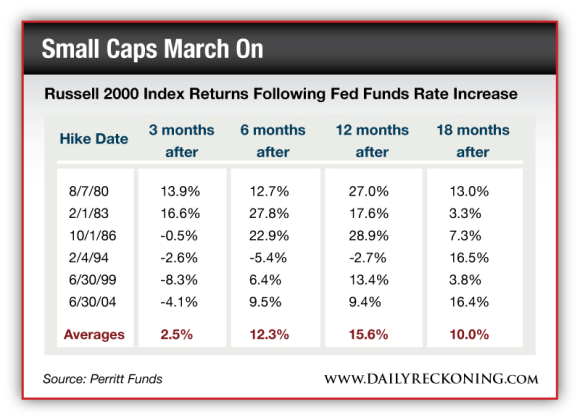
"Currently, the Fed is buying $85 billion a month in bonds and mortgage backed securities. If this was reduced by, say, $10 billion, it will be lauded as a 'taper.' But is it really? In my opinion, it’s still expansionary and inflationary. To the small cap sector, the data shows that it doesn’t matter. The positive performance of small caps after a rate-hike makes for a convincing argument. Different investors will recommend different strategies. Incorporating the smaller stocks in your investment portfolio might be something to consider if you fear the taper — or not." Continue reading

Continue ReadingDon’t Fear the Taper

Europe Puts on Its Rally Cap

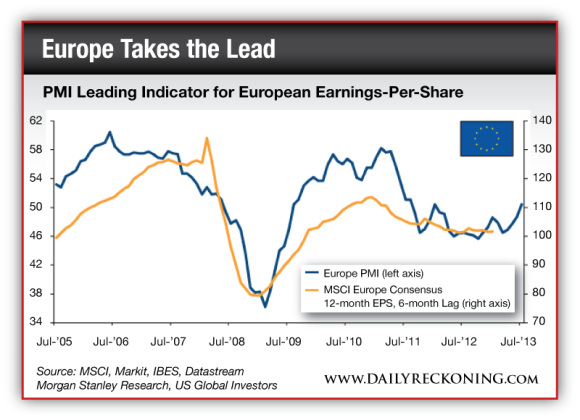
"Positive surprises and improving economic growth aren’t the only indications that the region’s economy is becoming healthier. Manufacturing appears to be on the mend. Europe has low valuations compared with the rest of the world. Take a look at the normalized price-earnings (P/E) ratio, which is trading at 'close to a record valuation low,' according to Morgan Stanley Research. Compared with U.S. stocks and world equities, European stocks are trading at a significant discount. So as countries including Germany, France and Italy recover, we have solid reasons to believe their eastern counterparts will enjoy a boost as well." Continue reading

Continue ReadingEurope Puts on Its Rally Cap

Where is This Legendary Investor Putting His Money?

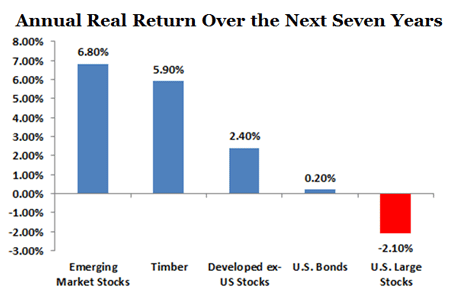
"Although Jeremy Grantham is not as celebrated as Warren Buffett or Jim Rogers, his status as a legend in the investment world is undisputed. Grantham is the co-founder and chief investment strategist at Grantham Mayo van Otterloo (GMO), where he oversees $100 billion in assets under management. He has built much of his investing reputation over his long career by successfully steering his clients away from bubbles and crashes. Grantham recently published his outlook for the next seven years. In it, he predicts that most asset classes will return little in the next few years. But there are a few exceptions." Continue reading

Continue ReadingWhere is This Legendary Investor Putting His Money?

Warren Buffett’s bubble cash-out strategy revealed in 38-year-old letter

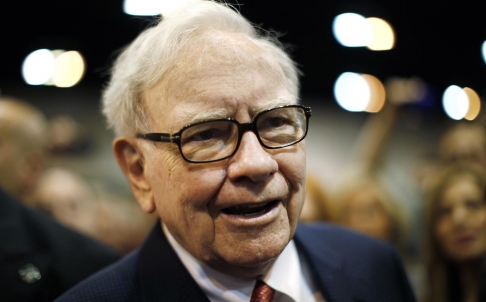
"A recently released 1975 letter offers new insight into how early Buffett was to grasp both the difficulties of pension fund management and the inability of Wall Street to provide adequate solutions. Perhaps even more valuable is the way the letter throws light on Buffett's approach to value investing. Buffett tries to act not like a typical fund manager but like a company owner thinking about buying another company. The crucial ingredients: patience, to get a good purchase price; courage, to stick with your investment if the business is doing well but the market doesn't agree; and a willingness to sell into a bubble when, as so often happens, one comes along." Continue reading

Continue ReadingWarren Buffett’s bubble cash-out strategy revealed in 38-year-old letter

Bill Bonner: Sooner or later, markets change

Bill-Bonner2

"What's a share in a company really worth? What's a bond worth? Heck, what's the dollar itself worth? All of these questions will draw the same reply: it depends. Among the things it depends on is the 'trust' in the society...in its leaders...in its capital structure...and in its future. When the sun is shining, it's easy to have trust in a society. It's when the chilly winds blow that the question marks begin to fly. You see them picked up by the gusts of wind like plastic bags...floating around until they are snagged on some barren tree. That's when it gets interesting...when the hopes and hallucinations that undergirded the boom give way. Our guess is that investors are about to go back to school." Continue reading

Continue ReadingBill Bonner: Sooner or later, markets change

Why Conservatives Accept High Taxes, the Federal Reserve System, and Fiat Money

portallogo3

"The alliance between the modern welfare state and the modern warfare state is based on the legitimacy of an ever-growing federal government: an ever-growing federal deficit, ever-increasing tax rates, and the permanence of the Federal Reserve. The liberals do not want to change the prevailing political system, and neither do the conservatives. The liberals want their welfare checks to go out, and so to the conservatives. The liberals want to push foreign nations around, and so to the conservatives. This is why taxes will not go down, the Federal Reserve will not be abolished, and the gold coin standard will not be re-established until such time as the Great Default bankrupts the federal government." Continue reading

Continue ReadingWhy Conservatives Accept High Taxes, the Federal Reserve System, and Fiat Money