
Progressivism: A Primer on the Idea Destroying America by James (Jim) Ostrowski.
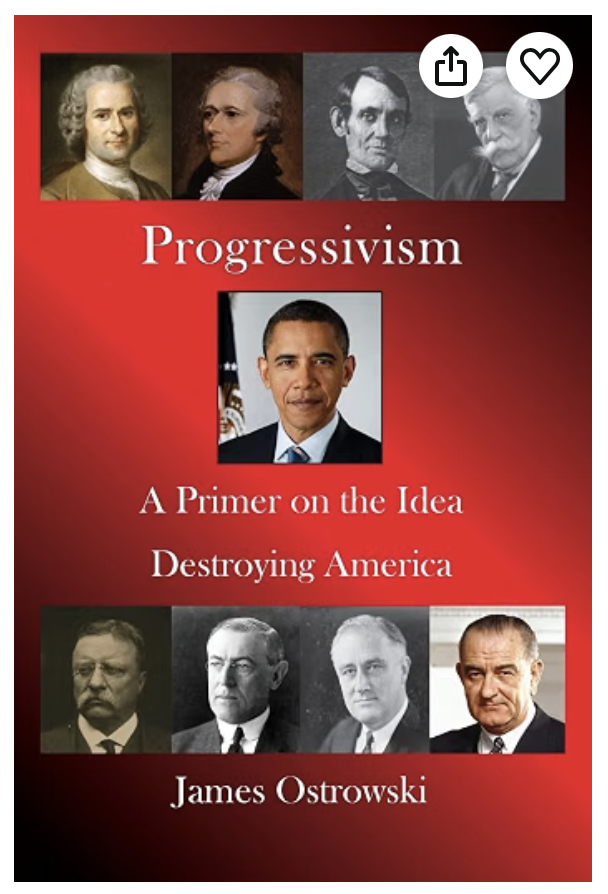
Right around the time of 9/11, state power began to win its age-old race with social power. The evidence described above demonstrates a nation in steady decline, unlikely to be reversed unless its causes, progressivism and its policies and consequences, are reversed. To help accomplish that reversal is the purpose of this book.
===========
This is just a tremendous book. I thoroughly enjoyed every word of Jim Ostrowski’s Progressivism. The author has lived much of his life in deep-blue New York and is far more libertarian than conservative. The thrust of his book is that liberty is in deep peril, and that nearly everyone today is essentially progressive, including vast swaths of the Republican Party and the conservative movement.
I imagine that’ll be a hard sell for those who see themselves as mortal enemies of progressivism, especially the Christian element of the Republican Party. And to that point, I suspect the author might have a softer tone if he had lived his life in Oklahoma rather than New York, seeing as how conservatives in New York and conservatives in Oklahoma aren’t at all the same thing.
Yet the author has his points.
As I read Ostrowski’s book, I found myself both delighted and disappointed. Delighted because I thoroughly enjoyed his argument, but disappointed because I realized that I couldn’t readily recommend the book to many of my Christian conservative friends here in Oklahoma. Not because it wasn’t worth reading, but because I fear it wouldn’t resonate with them.
And then, as I was reading, I thought back to another book I had read years ago: A Conflict of Visions by Thomas Sowell.
Now, if these same conservatives had first read Sowell, then Ostrowski’s arguments might make a great deal more sense!
In fact, I think it would be of tremendous benefit to the reader to first read A Conflict of Visions, and then Ostrowski’s Progressivism. Read Sowell first, then Jim Ostrowski, and everything snaps perfectly into focus.
A Conflict of Visions by Thomas Sowell

Controversies in politics arise from many sources, but the conflicts that endure for generations or centuries show a remarkably consistent pattern. In this classic work, Thomas Sowell analyzes this pattern. He describes the two competing visions that shape our debates about the nature of reason, justice, equality, and power: the “constrained” vision, which sees human nature as unchanging and selfish, and the “unconstrained” vision, in which human nature is malleable and perfectible. A Conflict of Visions offers a convincing case that ethical and policy disputes circle around the disparity between both outlooks
Sowell explains both the left and the right in what I consider his most underrated book. Truly, this is one of the absolute essentials that every conservative needs to read. I am constantly recommending it. It’s in my top ten, perhaps even my top five, favorite non-theological books.
Sowell explains that conservatives and the left do not simply disagree on a handful of political issues. They disagree fundamentally on the nature of man and how the world works. These disagreements are not merely political, but philosophical, and at their foundation lie two very different understandings of the world and human nature.
Sowell calls these the constrained and unconstrained visions.
I would sum up the distinction, particularly for the Christian reader, with two questions: Is man sinful and fallible? And if so, can man be fixed?
The Christian doctrine of fallen man provides a particularly useful way of understanding Sowell’s argument.
The constrained vision recognizes that man is inherently limited. He is selfish, fallible, and possessed of imperfect knowledge. These are not merely the consequences of bad institutions, improper education, or unfortunate circumstances. They are enduring features of the human condition. No amount of legislation, education, or enlightened political leadership can eliminate them.
The unconstrained vision, on the other hand, places much greater confidence in man’s capacity for improvement. Human shortcomings are regarded less as permanent limitations and more as problems that can be overcome through reason, education, and the deliberate improvement of society and its institutions.
This doesn’t mean that everyone on the left believes man is already perfect or incapable of evil. Rather, they tend to believe that the conditions producing our social problems can be sufficiently changed that those problems might eventually be overcome.
And therein lies the fundamental disagreement.
I sum it up this way: The left believes that the deep, foundational problems of the world can ultimately be solved, while the right accepts that such problems will always be with us.
Consequently, the conservative is more inclined to ask how evil can be restrained, wrongdoing punished, and the consequences of human fallibility mitigated. The progressive is more inclined to ask how society might be changed so that evil and wrongdoing can be prevented in the first place.
Of course, both conservatives and progressives wish to prevent evil, and both believe wrongdoing should be punished. The distinction is in their expectations of what political action can ultimately accomplish.
The conservative, recognizing the fallen nature of man, understands that we cannot legislate ourselves into utopia. We can improve our circumstances, but there will always be trade-offs, unintended consequences, and problems that no government can solve.
The progressive has considerably more confidence that the right policies, implemented by the right people, can fundamentally transform society and eliminate evil.
Never mind that nowadays the gulf between the left and right over what actually constitutes evil seems to be growing!
Now, having read Sowell, turn to Ostrowski.
Jim chronicles the history of progressivism, its rise to prominence in American political life, and the extent to which its underlying assumptions have infiltrated the conservative mind at nearly every level.
Ostrowski isn’t merely criticizing Democrats, socialists, or self-described progressives. He’s challenging Republicans and conservatives who have spent their lives opposing progressivism while accepting many of its underlying premises.
He points, for example, to government schooling and the major federal programs that Republican administrations have generally left intact and even defended. His argument is that the conservative movement has often accommodated the progressive state rather than fundamentally challenging its legitimacy.
And that raises the question: If conservatives accept the progressive assumption that government intervention is necessary to solve so many of society’s problems, how fundamentally different are they from the progressives they claim to oppose?
This is where Sowell becomes so valuable.
Having first understood the philosophical distinction between the constrained and unconstrained visions, the reader is better equipped to recognize the assumptions that Ostrowski identifies within the conservative movement itself.
One begins to see how a politician can sound thoroughly conservative on matters of religion, culture, and tradition while embracing a remarkably unconstrained vision of what government can accomplish, both at home and abroad.
And this is why I regard these two books, read together and in the proper order, as a devastating one-two punch against neoconservatism and progressivism. Indeed, one begins to realize that neoconservatism itself is really a misplaced progressive stepchild.
Sowell explains the underlying philosophical disagreement. Ostrowski then demonstrates how frequently conservatives have adopted the political assumptions of the very people they consider their opponents.
One supplies the intellectual foundation, and the other brings its implications into sharp focus.
Of course, Thomas Sowell’s book is a genuine classic, one of the most important books of the last forty years, and it has stood alone for a very long time.
But I suppose, too, that there must have been a time before dip, when people just ate chips and were happy.
Andrew Hayes is a farmer and rancher in SW Oklahoma.
He can be reached at hayes@mises.com
Editor’s note: Book covers at the top of the review are linked to Amazon for purchase. If you order with our direct link it will benefit our work here a little. Every little bit helps! Thanks for your support.
Shared via CLC Library

You must be logged in to post a comment.