I don’t know why you read. I would love to know. For me, the answer is straightforward. I suffer from ignorance. And reading books reduces that ignorance. I read almost exclusively non-fiction, heavy on economics, history, philosophy, with some psychology and some theology. The thing that drives most of my reading is a desire to know. And reading books is a means to that end.
But here, I’ll introduce you to an author who will absolutely reduce ignorance, but is delightful to read, in and of itself. Matt Ridley is the sort of author I read, just to read.
What I mean is that I’ll have a conversation with someone about a historical figure and find my knowledge lacking—or read a news piece about an event and pick up a book to get the background. I recently finished a book by Moshe Gat about the exodus of Jews from Iraq in the early 1950s.
But Matt Ridley isn’t that sort of writer. He’s the sort where you just buckle in and hang on! There’s really no telling where he might take you, or what you might learn that you didn’t even know you didn’t know.
Like anyone, I read authors I trust. Authors I know who are pretty much in alignment with my own thinking and my own worldview.
But I’ll also read a fair number of books I disagree with, partly to see if I might be wrong on a subject, but also, in large part, as a sort of enemy recon. I want to know the other side’s arguments before I encounter them in the wild. And it’s really a lot of fun when a leftist says, “You should read X,” and I say, “By Thomas Piketty? Yeah, I read that,” and then I can break down what he and the author miss.
But Ridley isn’t like either of these. There’s enough to agree with in Ridley’s writings that one can relax, and there’s enough to disagree with to keep things interesting.
We might as well be upfront about it. Matt Ridley is not a Christian, at least not the sort that would be recognizable to myself or any of my readers here. His books consistently reflect a secular, evolution-centered worldview. That will be discomforting to some, but I would highly encourage Christians to read his works anyway. The marvelous thing is that Ridley also consistently, throughout his books, declares, louder than most, the glory of creation and therefore the glory of the Creator, even if he himself tragically misses it.
His best two books are “The Rational Optimist” and “How Innovation Works.”
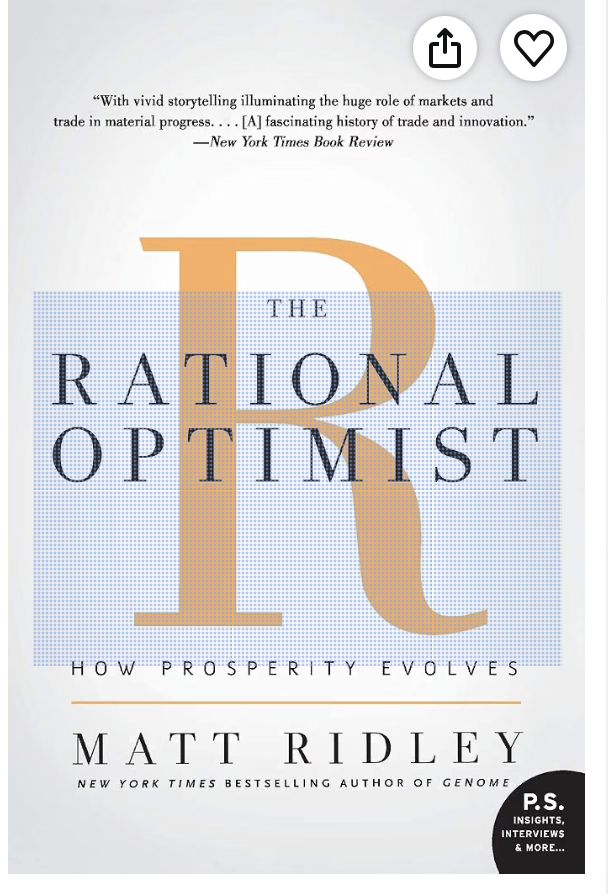
In a bold and provocative interpretation of economic history, Matt Ridley, the New York Times-bestselling author of Genome and The Red Queen, makes the case for an economics of hope, arguing that the benefits of commerce, technology, innovation, and change—what Ridley calls cultural evolution—will inevitably increase human prosperity. Fans of the works of Jared Diamond (Guns, Germs, and Steel), Niall Ferguson (The Ascent of Money), and Thomas Friedman (The World Is Flat) will find much to ponder and enjoy in The Rational Optimist.
For two hundred years the pessimists have dominated public discourse, insisting that things will soon be getting much worse. But in fact, life is getting better—and at an accelerating rate. Food availability, income, and life span are up; disease, child mortality, and violence are down all across the globe. Africa is following Asia out of poverty; the Internet, the mobile phone, and container shipping are enriching people’s lives as never before.
“How Innovation Works” is a book about everything—when it was new, and how it came into being. Everything from the telegraph to the cell phone. It’s really just a lot of fun. For instance, a theme throughout this book is that it is very often innovation that precedes scientific research. He backs up this claim over and over: for instance, the fact that the steam engine came first—and only after the steam engine did scientists begin to understand the laws of thermodynamics!
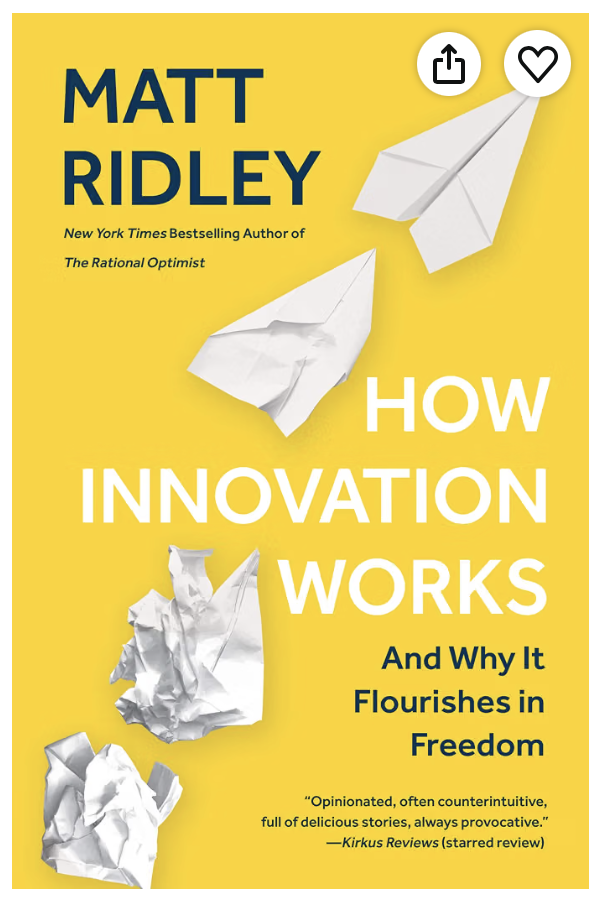
Matt Ridley argues that we need to see innovation as an incremental, bottom-up, fortuitous process that happens as a direct result of the human habit of exchange, rather than an orderly, top-down process developing according to a plan. Innovation is crucially different from invention, because it is the turning of inventions into things of practical and affordable use to people. It speeds up in some sectors and slows down in others. It is always a collective, collaborative phenomenon, involving trial and error, not a matter of lonely genius. It happens mainly in just a few parts of the world at any one time. It still cannot be modeled properly by economists, but it can easily be discouraged by politicians. Far from there being too much innovation, we may be on the brink of an innovation famine.
And then there’s the point that Thomas Edison—while most people remember him for inventing the lightbulb—should perhaps instead be remembered for making it practical and affordable, as there were about 20 others who independently invented the lightbulb!
“The Rational Optimist” is also fun but perhaps has a bit more serious of a tone to it. While there are people who, for one reason or another, say that things are getting worse, Ridley argues that the longer trend is that things are getting significantly better. Here Ridley is more focused on the state of the global environment, the alleged “using up” of natural resources, and feeding another billion people with fewer farm workers and fewer acres of farmland. He shows why it is specialization, exchange, and ultimately freedom that make things better. A fun book, and definitely one for your perpetually pessimistic friend on the left.
His other books are likewise interesting and generally heterodox in their view, so if you read and enjoy these two, you’ll likely enjoy his other books as well.
Andrew Hayes is a farmer and rancher in SW Oklahoma.
He can be reached at hayes@mises.com
Editor’s note: Book covers in the review are linked to Amazon for purchase. If you order with our direct link it will benefit our work here a little. Every little bit helps! Thanks for your support.
Shared via CLC Library
You must be logged in to post a comment.